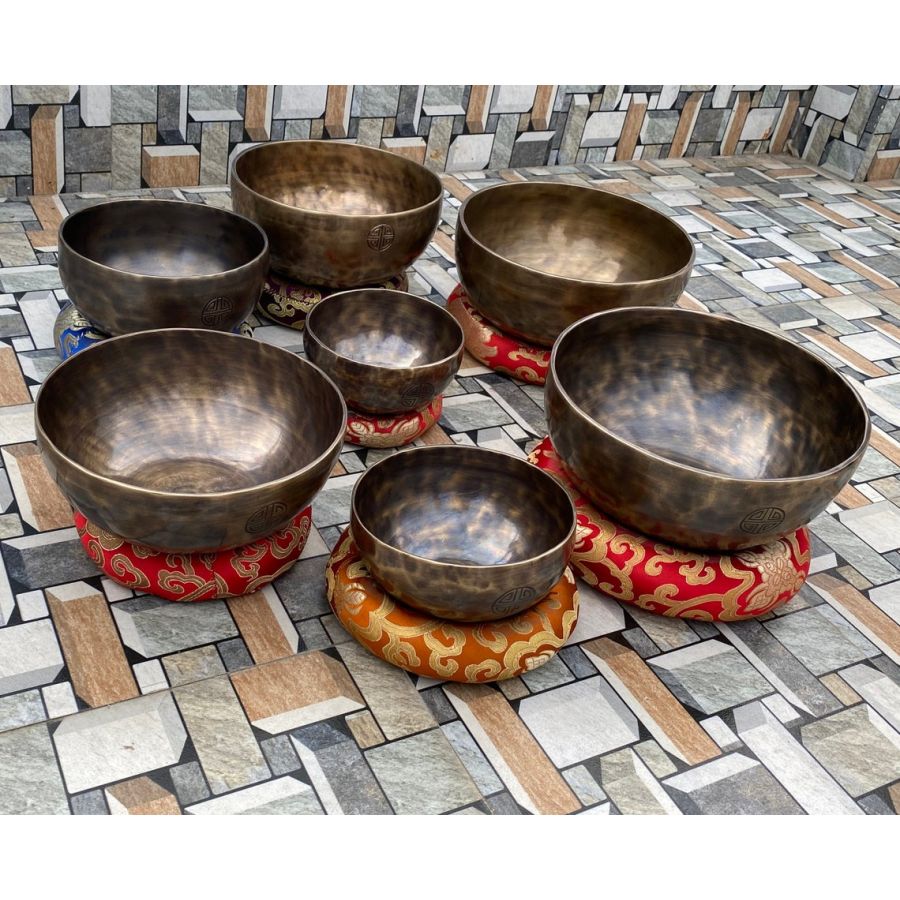
Handmade 7 metal Bronze chakra frequency tuned full moon singing bowl 7 Pcs Set
Weight: 14.29 kg Size: 15 - 28 cm Material: 7 Metal Bronze
About the Product
Full moon singing bowl is made by hand on a full moon evening of every month by enhancing the subtle moon energy for sound healing and chakra balancing Handmade high-quality sound healing Tibetan singing bowl made in Nepal.
Cleanses negative energy.
Meditation healing sound immersion therapy.
Best size Tibetan singing bowl.
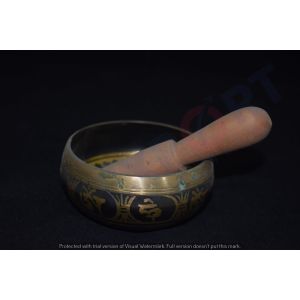
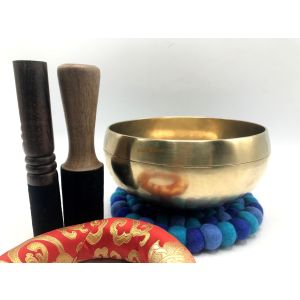
This singing bowl comes with Stick cushion and striker include as shown in pictures. Deep long-lasting beautiful sound gong. This singing bowl is made of seven metals. Those who are looking for real handmade singing bowls from Himalayan will not be disappointing by this bowl.
It comes with 7 stick 7cushion and 2 stricter including As shown in pictures
In Package you will receive: 7 Stick 7 Cushion and Singing Bowl set of seven and 2 felt drum sticks
-(This is a handmade item therefore please note that each one might have slight variations)
The seven chakra system
List of Seven Chakra And Attributes
Name of chakra
location and Sound
Description
Name: Sahasrara
Crown Chakra Keynote: B Frequency: 480 Hz. Vowel: Eee Bija: Om Element: All Sound: Om Energy: Transcendence
Highest spiritual centre pure consciousness containing neither object nor subject. When the feminine Kundalini Shakti rises to this point it unites with the masculine Shiva giving self-realization and samadhi. In esoteric Buddhism it is called Mahasukha the petal lotus of "Great Bliss" corresponding to the fourth state of Four Noble Truths.
Name: Ajna
Third Eye Chakra Keynote: A Frequency: 426.7 Hz. Vowel: Aye Bija: Sham Element: All Sound: Bells/Space Energy: Insight Wisdom
Guru chakra or third-eye chakra the subtle center of energy where the tantra guru touches the seeker during the initiation ritual (saktipata). He or she commands the awakened kundalini to pass through this centre.
Name: Vishuddha
Throat Chakra Keynote: G Frequency: 384 Hz. Vowel: Eye Bija: Ham Element: Ether Sound: Crickets Energy: Communication Creation
The Vishuddha is iconographically represented with 16 petals covered with the sixteen Sanskrit vowels. It is associated with the element of space (akasha) and has the seed syllable of the space element Ham at its centre. The residing deity is Panchavaktra shiva with 5 heads and 4 arms and the Shakti is Shakini.
In esoteric Buddhism it is called Sambhoga and is generally considered to be the petal lotus of "Enjoyment" corresponding to the third state of Four Noble Truths.
Name: Anahata
Heart Chakra Keynote: F Frequency: 341. 3 Hz. Vowel: Ah Bija: Yam Element: Air Sound: Wind Energy: Compassion Love
Within it is a yantra of two intersecting triangles forming a hexagram symbolising a union of the male and female as well as being the esoteric symbol for the element of air (vayu). The seed mantra of air Yam is at its centre. The presiding deity is Ishana Rudra Shiva and the Shakti is Kakini.
In esoteric Buddhism this Chakra is called Dharma and is generally considered to be the petal lotus of "Essential nature" and corresponding to the second state of Four Noble Truths
Name: Manipura
Sacral Navel Chakra Keynote: E Vowel: Oh Frequency: 320 Hz. Bija: Ram Element: Fire Sound: Roaring Fire Element: Fire Energy: Power
For the Nath yogi meditation system this is described as the Madhyama-Shakti or the intermediate stage of self-discovery. This chakra is represented as an downward pointing triangle representing fire in the middle of a lotus with ten petals. The seed syllable for fire is at its center Ram. The presiding deity is Braddha Rudra with Lakini as the Shakti
Name: Svadhishthana
Sacral Chakra Keynote: D Frequency: 288 Hz Vowel: Ooo Bija: Vam Element: Water Sound: Ocean Energy: Life Energy
Svadhisthana is represented with a lotus within which is a crescent moon symbolizing the water element. The seed mantra in its center is Vam representing water. The presiding deity is Brahma with the Shakti being Rakini (or Chakini).
In esoteric Buddhism it is called Nirmana the petal lotus of "Creation" and corresponding to the first state of Four Noble Truths
Name: Muladhara
Root Chakra Keynote: C Frequency: 256 Hz. Vowel: Uh Bija: Lam Element: Earth Sound: Thunder/Earthquake Energy: Grounding
Dormant Kundalini is often said to be resting here wrapped three and a half or seven or twelve times. Sometimes she is wrapped around the black Svayambhu linga the lowest of three obstructions to her full rising (also known as knots or granthis).
It is symbolised as a four-petaled lotus with a yellow square at its center representing the element of earth.
The seed syllable is Lam for the earth element (pronounced lum) . All sounds words and mantras in their dormant form rest in the muladhara chakra where Ganesha resides while the Shakti is Dakini. The associated animal is the elephant
Inclusive Accessories
Process : Hand Beaten Singing Bowl
The seven metals and their planetary associations are 1. Gold (Sun) 2. Silver (Moon) 3. Copper (Venus) 4. Iron (Mars) 5. Tin (Jupiter) 6. Mercury/Quicksilver (Mercury) 7. Lead (Saturn) all of which feature heavily in alchemical symbolism
Making of Hand Hammered Singing bowls
Singing Bowls:
What is Singing Bowls?
Singing bowls also known as Himalayan bowls are used in yoga music therapy sound healing and religious ceremonies. In the Buddhist tradition they are played to signal the beginning and the end of silent meditation cycles. Tibetan bowls emit very pure tones close to sine waves. Their sound is a synonym of purity for our ears.
Like a bell the tone is produced by striking the side of the bowl with a wooden mallet. By running the mallet around the bowl - only with slight pressure - a pure tone will eventually rise. When this happens the bowl is said to sing - hence its name.How To Play Tibetan Singing Bowls1. Hold the singing bowl on the palm of the left hand. For smaller bowls seven inches and under hold on your fingertips. 2. Grasp the mallet about mid-length with all the fingertips pointing downwards and touching the wood. (If you are using one of our padded mallets the red wool should be on top.) Palm downward. 3. Gently tap the mallet against the side of the bowl to "warm-up" the bell. 4. With an even pressure rub the mallet clockwise around the outside edge of the rim of the bowl. Use a full arm movement just like stirring a big kettle of soup and keep the mallet straight up and down! Again it's not a wrist movement but a full-arm movement.
Remember to apply pressure-- the friction of the mallet against the outer rim produces vibrations which result in sound.
Experiment with your speed. Usually people go too fast! Let the sound build up slowly as the singing bowl picks up the vibrationHow To Play Tibetan Singing Bowls -Breaking in Your MalletThe mallet that comes with your Tibetan singing bowl is handmade of Himalayan hardwood. When you play the bowl using the mallet-around-the-rim technique the friction of the mallet produces vibrations which result in sound. In the beginning the mallet is relatively smooth but as you continue to use it it will develop "micro-grooves" shallow grooves which help to grab more of the playing edge of the bowl. Allow about five minutes for initial break-in of a new mallet. As you use the mallet more the micro-grooves become impressed in the mallet and you will get better sound and easier playig from your bowl.How To Play Tibetan Singing Bowls -The Wah-Wah1. Most all Tibetan singing bowls have natural wah-wahs which you can amplify and bend by using the wah-wah technique. 2. Get the bowl singing by using the mallet-around-the-rim technique described above. Pull the mallet away from the bowl and let the bowl continue to sing. 3. While still holding the bowl in your hand raise the bowl up to your mouth so that the outside rim is just above the opening of your mouth and about an inch away.
Open and close your mouth while thinking of the sound wah-wah. You are not actually making any sound with your mouth but simply changing the shape of the oral cavity so as to allow the sound of the singing bowl to bounce around inside of your mouth and then be reflected back. By changing the size of the oral cavity you are modulating the sound!
Experiment with the relative position of your mouth to the outside bowl rim. Also if you turn the bowl while experimenting with the wah-wah effect you will find "hot spots" where the bowl is naturally louder.How To Play Tibetan Singing Bowls -Water Bowl SoundsA special sound effect can be produced by adding a small amount of water to the bottom of the singing bowl. The sounds produced using this technique sound like dolphins singing!
1. The amount of water to use varies with the individual bowl. Start by pouring about 3/4" of water into the bowl. Be careful NOT to get the outside rim of the bowl wet. 2. Now play the bowl using the mallet-around- the-rim technique. Bring up the sound by using a steady even pressure. Pull the mallet away from the bowl rim and let the bowl continue to sing. 3. Still holding the bowl in your hand tilt the bowl so that the water inside gently laps up toward the inside rim. Continue to gently swirl and tilt the bowl and the water.
Experiment with the amount of water used. Usually the best effect is produced with a minimum amount of water. Keep a towel handy in case of spills.
Isolating the Fundamental
This technique requires awareness breath and concentration. If you have a fairly thin-walled Buddha bowl you can isolate the fundamental (bass tone) by using a leather-covered mallet. Follow the instructions regarding your rimming technique for the female overtone only use the leather end of your mallet for rimming and make sure your mallet is pointed straight up. Experiment with using a lighter pressure.