AMOGHASSIDDHI BUDDHA : BRIEF INTRODUCTION
Amoghasiddhis is one of the five important Dhyani Buddhas. His name describes his characteristics perfectly. Amogha(Amoha) means exclusion of confusion or spiritual ignorance, siddhi means Mastery in a subject. So in Amoghashiddhi is a Master to help remove confusion and spiritual ignorance.
"Mogha" can also be translated as failure, unfruitful, or unsuccessful. Thus Amoghasiddhi is also the master of success, the one whose success cannot be obstructed. This is perhaps the most common description for Amoghasiddhi, "the Buddha of unobstructed success."
AMOGHASSIDDHI BUDDHA : BRIEF INTRODUCTION
Amoghasiddhis is one of the five important Dhyani Buddhas. His name describes his characteristics perfectly. Amogha(Amoha) means exclusion of confusion or spiritual ignorance, siddhi means Mastery in a subject. So in Amoghashiddhi is a Master to help remove confusion and spiritual ignorance.
"Mogha" can also be translated as failure, unfruitful, or unsuccessful. Thus Amoghasiddhi is also the master of success, the one whose success cannot be obstructed. This is perhaps the most common description for Amoghasiddhi, "the Buddha of unobstructed success."
TEACHINGS OF AMOGHASHIDDI
Amoghasiddhi teaches us that Spiritual understanding is the deepest and fullest grasp of the universal truth that every experience and every object arises out of certain conditions. Likewise, every object and every experience becomes part of the conditions out of which other objects and experiences in turn arise.
A dynamic, endlessly unfolding. That is Amoghasiddhi's field, his home. So the wisdom of dwelling in this place is the wisdom of actions that are perfected. Actions are performed for the good of all beings, and the actions accomplish that perfectly. This world of perfected action is one of perfected conditions: harmonious, serene, pure.
ICONGRAPHY OF AMOGSHIDDHI
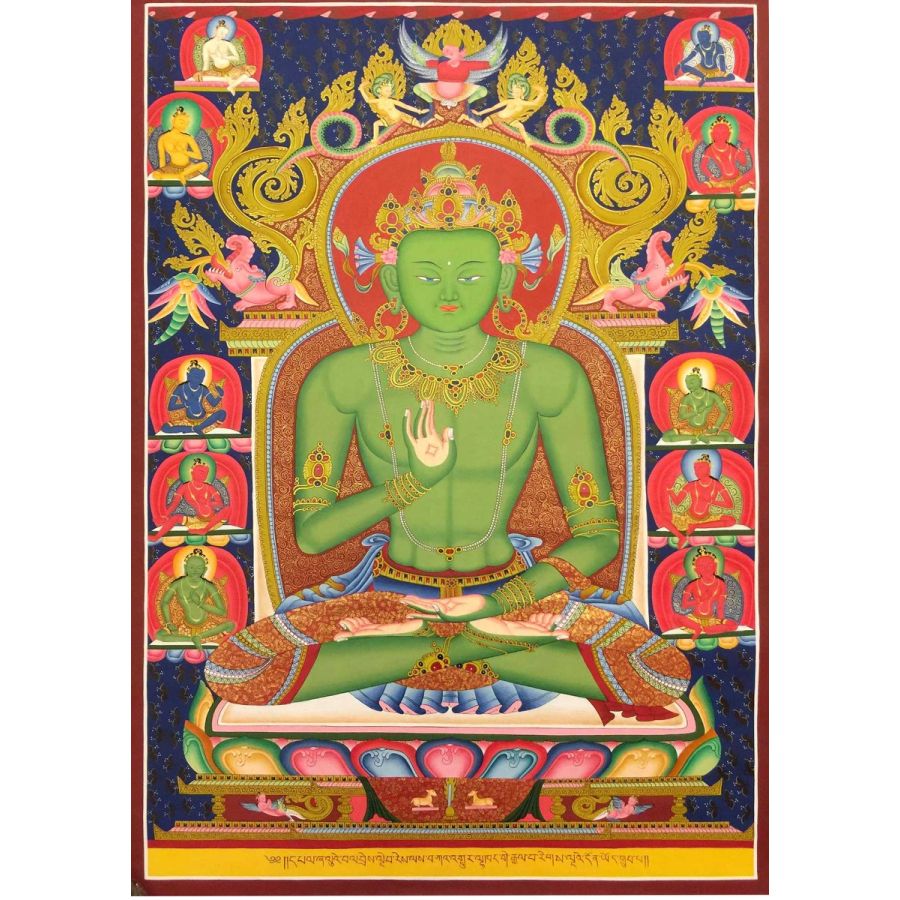
Amoghasddhi's direction is the north. His time is midnight and so in visualizing Amoghasiddhi he is surrounded by a sky of midnight blue. His element is air, and thus he has the power of the wind, both fierce and gentle, warming and cooling, a baby's breath, a tree-breaker. His particular wisdom, as we have discovered, is the wisdom of all accomplishing action. He is described as the Buddha of the realization of the Bodhisattva path, a Buddha of actions, actions perfected and free of karmic consequences, actions that are pure, crystallized and transparent.
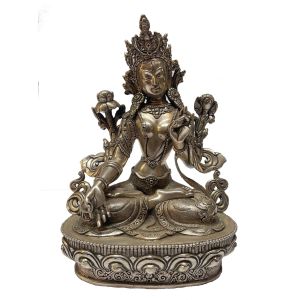
Amoghasiddhi's color is green. His vehicle is Garudha a half human and half bird, mythical imaginary creature. Amoghasiddhi's sits in abhaya mudra with his right hand held palm facing outward in front of the heart, this Mudras mean protection and removal of fear. That quality of fearlessness essential to living the spiritual life. His spiritual object is the double dorje that symbolizes the highest comprehension of truth, the incomparable power of a Buddha.
INTRODUCTION TO NEWARI PAUBHA [ पौभा ]
Paubhā (Devanagari: पौभा) is a traditional religious painting made by the Newar people of Nepal. Paubhas depict deities, mandalas or monuments, and are used to help the practitioner meditate. The Tibetan equivalent is known as Thangka. Most paubhas show Buddhist subjects, but a few have Hindu themes. The paintings are made to earn religious merit both for the artist and the patron. Newar Buddhists commission artists to paint paubhas which are displayed during festivals and other special occasions. The traditional painters of paubhas are the Chitrakar caste who are known as Pun (पुं) in Nepal Bhasa