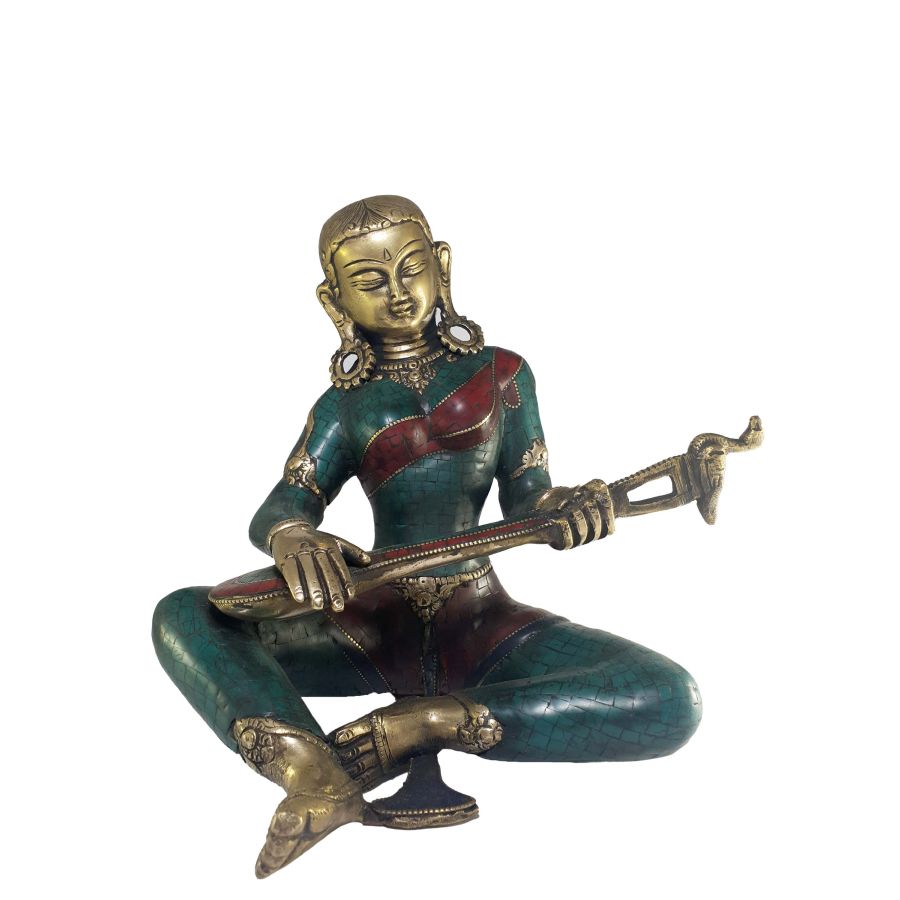
Statue of Saraswati with Real Stone Setting , Better Work

In stock
Export
SKU
HME22323
$190.00
Statue of Saraswati with Real Stone Setting , Better Work code: HME22323 Weight : 6.63 Kg(s) size :22x24x18 Cm
Shipping Term :
FOB
Unit Of Measure:
Pcs
Package Weight:
6.63 kgs
Min Order Qty:
10
Max Order Qty:
1
Available Stock:
1

This product is fulfilled by seller
More Information
Seller Handmade Handicraft
Product Tags Handmade, Handicraft, Craft, Statue, God Saraswati, Light of Education God, Saraswati, Saraswati Statue, Saraswati with Real Stone
UK Size 4
Seller Admin
Seller Countries: Nepal

Statue of Saraswati with Real Stone Setting Better Work

Weight: 6.63 kg
Size: 22x24x18 cm
Material: Brass and Stone


About the Product

Finishing: Stone Setting

Process: Sand Casting


The process cycle for sand casting consists of six main stages which are explained below
Mold-making -The first step in the sand casting process is to create the mold for the casting. In an expendable mold process this step must be performed for each casting. A sand mold is formed by packing sand into each half of the mold. The sand is packed around the pattern which is a replica of the external shape of the casting. When the pattern is removed the cavity that will form the casting remains. Any internal features of the casting that cannot be formed by the pattern are formed by separate cores which are made of sand prior to the formation of the mold. Further details on mold-making will be described in the next section. The mold-making time includes positioning the pattern packing the sand and removing the pattern. The mold-making time is affected by the size of the part the number of cores and the type of sand mold. If the mold type requires heating or baking time the mold-making time is substantially increased. Also lubrication is often applied to the surfaces of the mold cavity in order to facilitate removal of the casting. The use of a lubricant also improves the flow the metal and can improve the surface finish of the casting. The lubricant that is used is chosen based upon the sand and molten metal temperature.

Clamping - Once the mold has been made it must be prepared for the molten metal to be poured. The surface of the mold cavity is first lubricated to facilitate the removal of the casting. Then the cores are positioned and the mold halves are closed and securely clamped together. It is essential that the mold halves remain securely closed to prevent the loss of any material.
Pouring - The molten metal is maintained at a set temperature in a furnace. After the mold has been clamped the molten metal can be ladled from its holding container in the furnace and poured into the mold. The pouring can be performed manually or by an automated machine. Enough molten metal must be poured to fill the entire cavity and all channels in the mold. The filling time is very short in order to prevent early solidification of any one part of the metal.

Cooling - The molten metal that is poured into the mold will begin to cool and solidify once it enters the cavity. When the entire cavity is filled and the molten metal solidifies the final shape of the casting is formed. The mold can not be opened until the cooling time has elapsed. The desired cooling time can be estimated based upon the wall thickness of the casting and the temperature of the metal. Most of the possible defects that can occur are a result of the solidification process. If some of the molten metal cools too quickly the part may exhibit shrinkage cracks or incomplete sections. Preventative measures can be taken in designing both the part and the mold and will be explored in later sections.

Removal - After the predetermined solidification time has passed the sand mold can simply be broken and the casting removed. This step sometimes called shakeout is typically performed by a vibrating machine that shakes the sand and casting out of the flask. Once removed the casting will likely have some sand and oxide layers adhered to the surface. Shot blasting is sometimes used to remove any remaining sand especially from internal surfaces and reduce the surface roughness.

Trimming - During cooling the material from the channels in the mold solidifies attached to the part. This excess material must be trimmed from the casting either manually via cutting or sawing or using a trimming press. The time required to trim the excess material can be estimated from the size of the casting's envelope. A larger casting will require a longer trimming time. The scrap material that results from this trimming is either discarded or reused in the sand casting process. However the scrap material may need to be reconditioned to the proper chemical composition before it can be combined with non-recycled metal and reused.


Saraswati: Brief Introduction

In Hinduism Saraswati is the goddess of knowledge music arts science and technology. She is the consort of Brahma also revered as His Shakti.
The name Saraswati came from "saras" (meaning "flow") and "wati" (meaning "a woman"). So Saraswati is a symbol of knowledge; its flow (or growth) is like a river and knowledge is supremely alluring like a beautiful woman. She is depicted as a beautiful fair Goddess with Four arms wearing a spotless white saree and seated on a white lotus. She is also known as "Sharada" "Vani" and "Vagdevi" (both meaning "speech").
Iconographyhe goddess Saraswati is often depicted as a beautiful woman dressed in pure white often seated on a white lotus which symbolizes that she is founded in the experience of the Absolute Truth. Thus she not only has the knowledge but also the experience of the Highest Reality. She is mainly associated with the color white which signifies the purity of true knowledge. Occasionally however she is also associated with the colour yellow the colour of the flowers of the mustard plant that bloom at the time of her festival in the spring. She is adorned with simple jewels and gold unlike the goddess Lakshmi; representing her preference of knowledge over worldly material things.


She is generally shown to have four arms which represent the four aspects of human personality in learning: mind intellect alertness and ego. Alternatively these four arms also represent the 4 Vedas the primary sacred books for Hindus. The Vedas in turn represent the 3 forms of literature:


Poetry — the Rigveda contains hymns representing poetry

Prose — Yajurveda contains prose

Music — Samaveda represents music.


The four hands also depict this thus — prose is represented by the book in one hand poetry by the garland of crystal music by the veena. The pot of sacred water represents purity in all of these three or their power to purify human thought.

She is shown to hold the following in her hands:

A book which is the sacred Vedas representing the universal divine eternal and true knowledge as well as her perfection of the sciences and the scriptures.

A mala (rosary) of crystals representing the power of meditation and spirituality.

A pot of sacred water representing creative and purification powers.

The vina a musical instrument that represents her perfection of all arts and sciences. Saraswati is also associated with anurāga the love for and rhythm of music which represents all emotions and feelings expressed in speech or music.

The beautiful human form of Saraswati comes to the fore in this English translation of the Saraswati hymn:

"May Goddess Saraswati who is fair like the jasmine-colored moon and whose pure white garland is like frosty dew drops who is adorned in radiant white attire on whose beautiful arm rests the veena and whose throne is a white lotus who is surrounded and respected by the Gods protect me.May you fully remove my lethargy sluggishness and ignorance."

A hamsa or swan is often located next to her feet. The sacred bird if offered a mixture of milk and water is said to be able to drink the milk alone. It thus symbolizes discrimination between the good and the bad or the eternal and the evanescent. Due to her association with the bird Saraswati is also referred to as Hamsavahini which means "she who has a hamsa as her vehicle".


She is usually depicted near a flowing river which may be related to her early history as a river goddess.


Sometimes a peacock is shown beside the goddess. The peacock represents arrogance and pride over its beauty and by having a peacock as her mount the Goddess teaches not to be concerned with external appearance and to be wise regarding the eternal truth.MythologyIn the Rigveda Saraswati is a river as well as its personification as a goddess. In the post-Vedic age she began to lose her status as a river goddess and became increasingly associated with literature arts music etc. In Hinduism Saraswati represents intelligence consciousness cosmic knowledge creativity education enlightenment music the arts eloquence and power. Hindus worship her not only for "academic knowledge" but for "divine knowledge" essential to achieve moksha.


In some Puranas (like Skanda Purana) she is daughter of Shiva (Shivaanujaa) and in some Tantras with Ganesha. However across India she is worshipped as the wife of Lord Brahma. In the Devi Mahatyam it mentions her as Brahmapatni. According to some sects Saraswati was born from the left body part of Vishnu when Vishnu was in his eternal sleep.

The original (spiritual) forms of devas including Saraswati are present in the spiritual world:


In the center reside the deities of fire sun and moon Kurma-avatara Ananta Sesha and Garuda the master of the three Vedas. The Vedic hymns and all sacred mantras also stay in that holy place which is made of all the Vedas and which is known in the Smriti-sastra [Scriptures of Remembrance] as the yoga-pitha [Sanctuary of Union]. (Padma Purana Uttara-khanda 256.23)


Accompanied by Lakshmi and other associates the chatur-vyuha [Four Expansions] headed by Lord Vasudeva are manifest in the eight directions beginning with the east. In the directions beginning with the southeast the palaces of Lakshmi Saraswati Rati and Kanti respectively are situated.[clarification needed]

According to Vedanta she is considered to be the feminine energy and knowledge aspect (Shakti) of Brahma as one of many aspects of Adi Shakti. 

Write Your Own Review
Only registered users can write reviews. Please Sign in or create an account
You may also like