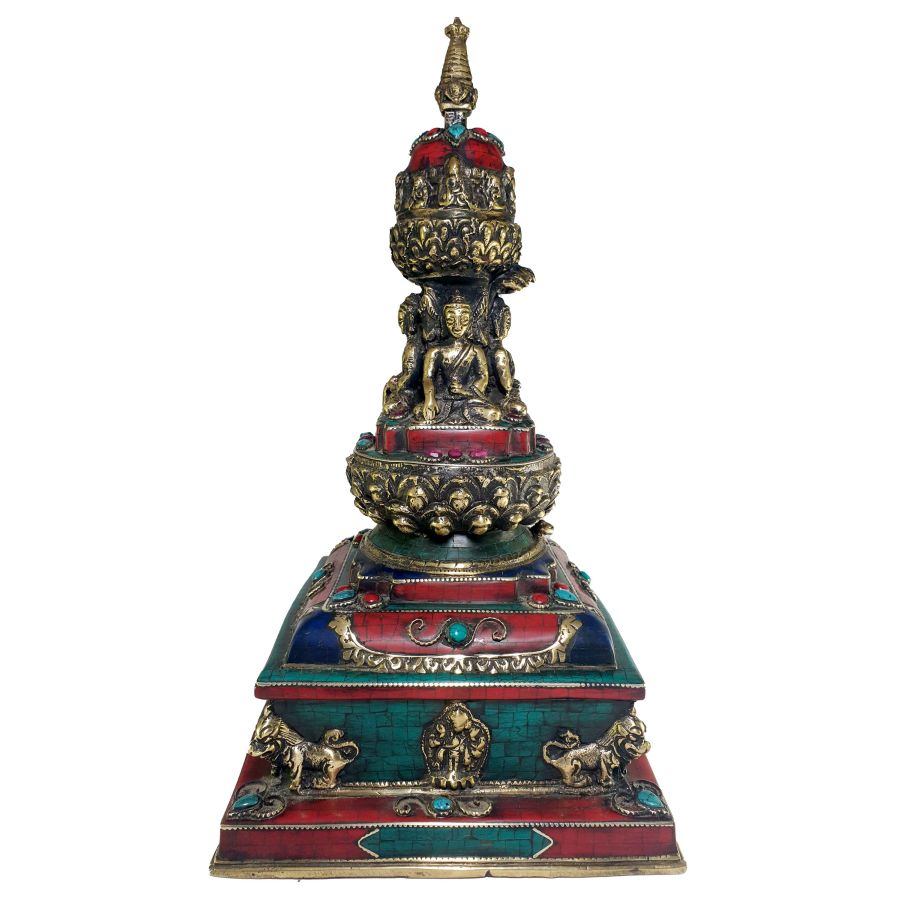
Statue of Stupa with Real Stone Setting , Better Work
| Seller | Handmade Handicraft |
|---|---|
| Product Tags | Handmade, Handicraft, Craft, Statue, Buddha Stupa, Buddha Temple, Statue of Stupa, Stupa Statue, Stupa with Real Stone Setting |
| UK Size | 4 |
| Seller | Admin |
| Seller | Handmade Handicraft |
|---|---|
| Product Tags | Handmade, Handicraft, Craft, Statue, Buddha Stupa, Buddha Temple, Statue of Stupa, Stupa Statue, Stupa with Real Stone Setting |
| UK Size | 4 |
| Seller | Admin |
Statue of Stupa with Real Stone Setting Better Work
Weight: 3.67 kg
Size: 29x15x16 cm
Material: Brass and Stone
About the Product
Finishing: Stone Setting
Process: Sand Casting
The process cycle for sand casting consists of six main stages which are explained below
Mold-making -The first step in the sand casting process is to create the mold for the casting. In an expendable mold process this step must be performed for each casting. A sand mold is formed by packing sand into each half of the mold. The sand is packed around the pattern which is a replica of the external shape of the casting. When the pattern is removed the cavity that will form the casting remains. Any internal features of the casting that cannot be formed by the pattern are formed by separate cores which are made of sand prior to the formation of the mold. Further details on mold-making will be described in the next section. The mold-making time includes positioning the pattern packing the sand and removing the pattern. The mold-making time is affected by the size of the part the number of cores and the type of sand mold. If the mold type requires heating or baking time the mold-making time is substantially increased. Also lubrication is often applied to the surfaces of the mold cavity in order to facilitate removal of the casting. The use of a lubricant also improves the flow the metal and can improve the surface finish of the casting. The lubricant that is used is chosen based upon the sand and molten metal temperature.
Clamping - Once the mold has been made it must be prepared for the molten metal to be poured. The surface of the mold cavity is first lubricated to facilitate the removal of the casting. Then the cores are positioned and the mold halves are closed and securely clamped together. It is essential that the mold halves remain securely closed to prevent the loss of any material.
Pouring - The molten metal is maintained at a set temperature in a furnace. After the mold has been clamped the molten metal can be ladled from its holding container in the furnace and poured into the mold. The pouring can be performed manually or by an automated machine. Enough molten metal must be poured to fill the entire cavity and all channels in the mold. The filling time is very short in order to prevent early solidification of any one part of the metal.
Cooling - The molten metal that is poured into the mold will begin to cool and solidify once it enters the cavity. When the entire cavity is filled and the molten metal solidifies the final shape of the casting is formed. The mold can not be opened until the cooling time has elapsed. The desired cooling time can be estimated based upon the wall thickness of the casting and the temperature of the metal. Most of the possible defects that can occur are a result of the solidification process. If some of the molten metal cools too quickly the part may exhibit shrinkage cracks or incomplete sections. Preventative measures can be taken in designing both the part and the mold and will be explored in later sections.
Removal - After the predetermined solidification time has passed the sand mold can simply be broken and the casting removed. This step sometimes called shakeout is typically performed by a vibrating machine that shakes the sand and casting out of the flask. Once removed the casting will likely have some sand and oxide layers adhered to the surface. Shot blasting is sometimes used to remove any remaining sand especially from internal surfaces and reduce the surface roughness.
Trimming - During cooling the material from the channels in the mold solidifies attached to the part. This excess material must be trimmed from the casting either manually via cutting or sawing or using a trimming press. The time required to trim the excess material can be estimated from the size of the casting's envelope. A larger casting will require a longer trimming time. The scrap material that results from this trimming is either discarded or reused in the sand casting process. However the scrap material may need to be reconditioned to the proper chemical composition before it can be combined with non-recycled metal and reused.
Stupa: Brief Introduction
A stupa is a mound-like structure containing Buddhist relics typically the remains of Buddha used by Buddhists as a place of worship. The stupa is the oldest Buddhist religious monument and was originally only a simple mound of mud or clay to cover supposed relics of the Buddha (cetiya). After the parinirvana of the Buddha his remains were cremated and the ashes divided and buried under eight stupas with two further stupas encasing the urn and the embers. Little is known about these early stupas particularly since it has not been possible to identify the original ten monuments. However some later stupas such as at Sarnath and Sanchi seem to be embellishments of earlier mounds.
The shape of the stupa represents the Buddha crowned and sitting in meditation posture on a lion throne. His crown is the top of the spire; his head is the square at the spire's base; his body is the vase shape; his legs are the four steps of the lower terrace and the base is his throne.
IconographyThere are eight different kinds of stupas in Tibetan Buddhism each referring to major events in the Buddha's life.
Lotus Blossom Stupa
Also known as Stupa of Heaped Lotuses or Birth of the Sugata Stupa this stupa refers to the birth of the Buddha. "At birth Buddha took seven steps in each of the four directions" (East South West and North). In each direction lotuses sprang symbolizing the Four Immeasurables: love compassion joy and equanimity. The four steps of the basis of this stupa is circular and it is decorated with lotus-petal designs. Occasionally seven heaped lotus steps are constructed. These refer to the seven first steps of the Buddha.
Enlightenment Stupa
Also known as the Stupa of the Conquest of Mara. This stupa symbolizes the 35-year-old Buddha's attainment of enlightenment under the bodhi tree in Bodh Gaya where he conquered worldly temptations and attacks manifesting in the form of Mara.
Stupa of Many Doors
Also known as the Stupa of Many Gates. After reaching enlightenment the Buddha taught his first students in a deer-park near Sarnath. The series of doors on each side of the steps represent the first teachings: the Four Noble Truths the Six Perfections the Noble Eightfold Path and the Twelve Links in the Chain of Dependent Origination.
Stupa of Descent from the God Realm
At 42 years old Buddha spent a summer retreat in Tushita Heaven where his mother had taken rebirth. In order to repay her kindness he taught the dharma to her reincarnation. Local inhabitants built a stupa like this in Sankasya in order to commemorate this event. This stupa is characterized by having a central projection at each side containing a triple ladder or steps.
Stupa of Great Miracles
Also known as Stupa of Conquest of the Tirthikas. This stupa refers to various miracles performed by the Buddha when he was 50 years old. Legend claims that he overpowered maras and heretics by engaging them in intellectual arguments and also by performing miracles. This stupa was raised by the Lichavi kingdom to commemorate the event.
Stupa of Reconciliation
This stupa commemorates the Buddha's resolution of a dispute among the sangha. A stupa in this design was built in the kingdom of Magadha where the reconciliation occurred. It has four octagonal steps with equal sides.
Stupa of Complete Victory
This stupa commemorates Buddha's successful prolonging of his life by three months. It has only three steps which are circular and unadorned.
Stupa of Nirvana
This stupa refers to the death of the Buddha when he was 80 years old. It symbolizes the Buddha's complete absorption into the highest state of mind. It is bell-shaped and usually not ornamented.Inside The StupaAll stupas contain a treasury filled with various objects. Small offerings called Tsa-Tsas fill a major part of the treasury. Creation of various types of Tsa-Tsas is a ceremony itself. Mantras written on paper are rolled into thin rolls and put into these small clay stupas. Filling the treasury one layer of Tsa-Tsas are placed and the empty space between is filled with dry sand. On the new surface appearing another layer is made until the entire space of a treasury is full.
The number of Tsa-Tsas are dependent on the size of both the treasury and Tsa-Tsa since it should be completely filled. For example the Kalachakra stupa in southern Spain has approximately 14 000 Tsa-Tsas within.
Jewellery and other "precious" objects are also placed in the treasury. It is not necessary that the jewellery be expensive since it is the symbolic value that is important not the market price. It is believed that the more objects placed into the stupa the stronger the energy of the Stupa will beChaitya : Brief IntroductionChaitya or the Stupa which represents the Buddhist Universe is the Buddhist sanctuary sometimes square and sometimes round with spires or steps on the capital. Each spire or step represents a heaven the uppermost portion being a point which is supposed to be the highest peak of Mount Sumeru a mythical mountain hence the Buddhichitta loses itself in sunya. On the four sides of the chaitya the figures of your Dhyani Buddhas Akkshobhaya. Ratna Sambhav Amitabha Amoghasiddhi are placed. The place of Vairochana is in the center. In some Chaitya Vairochana is placed to the east along with Akshobhaya.