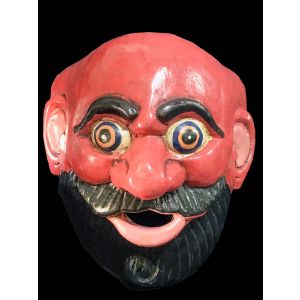
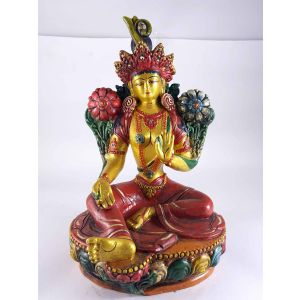
that the face of the statue is to be greatly taken care of as it requires a very professional and skilled face artist to repair the face of dirt and damages. Commonly to protect it from damage the statue with painted face is placed under a glass box and it is always covered with a cotton face mask if it has to be moved
Fire-gilding or Wash-gilding is a process by which an amalgam of gold is applied to metallic surfaces the mercury being subsequently volatilized leaving a film of gold or an amalgam containing 13 to 16% mercury. In the preparation of the amalgam the gold must first be reduced to thin plates or grains which are heated red-hot and thrown into previously heated mercury until it begins to smoke. When the mixture is stirred with an iron rod the gold is totally absorbed. The proportion of mercury to gold is generally six or eight to one. When the amalgam is cold it is squeezed through chamois leather to separate the superfluous mercury; the gold with about twice its weight of mercury remains behind forming a yellowish silvery mass with the consistency of butter.
When the metal to be gilded is wrought or chased it ought to be covered with mercury before the amalgam is applied that this may be more easily spread; but when the surface of the metal is plain the amalgam may be applied to it directly. When no such preparation is applied the surface to be gilded is simply bitten and cleaned with nitric acid. A deposit of mercury is obtained on a metallic surface using quicksilver water a solution of mercury(II) nitrate the nitric acid attacking the metal to which it is applied and thus leaving a film of free metallic mercury.
The amalgam is equally spread over the prepared surface of the metal the mercury is then sublimed by heat just sufficient for that purpose; for if it is too great part of the gold may be driven off or it may run together and leave some of the surface of the metal bare. When the mercury has evaporated which is known by the surface having entirely become of a dull yellow color the metal must undergo other operations by which the fine gold color is given to it. First the gilded surface is rubbed with a scratch brush of brass wire until its surface is smooth.
It is then covered with gilding wax and again exposed to fire until the wax is burnt off. Gilding wax is composed of beeswax mixed with some of the following substances: red ochre verdigris copper scales alum vitriol and borax. By this operation the color of the gilding is heightened and the effect seems to be produced by a perfect dissipation of some mercury remaining after the former operation. The gilt surface is then covered over with potassium nitrate alum or other salts ground together and mixed into a paste with water or weak ammonia. The piece of metal thus covered is exposed to heat and then quenched in water.
By this method its color is further improved and brought nearer to that of gold probably by removing any particles of copper that may have been on the gilt surface. This process when skillfully carried out produces gilding of great solidity and beauty but owing to the exposure of the workmen to mercurial fumes it is very unhealthy. There is also much loss of mercury to the atmosphere which brings extremely serious environmental concerns as well.
This method of gilding metallic objects was formerly widespread but fell into disuse as the dangers of mercury toxicity became known. Since fire-gilding requires that the mercury be volatilized to drive off the mercury and leave the gold behind on the surface it is extremely dangerous. Breathing the fumes generated by this process can quickly result in serious health problems such as neurological damage and endocrine disorders since inhalation is a very efficient route for mercuric compounds to enter the body. This process has generally been supplanted by the electroplating of gold over a nickel substrate which is more economical and less dangerous.
 Before Making statue :At work room making the wax models. Before Making statue :At work room making the wax models.
|  Softening a piece of wax over a brazier. Softening a piece of wax over a brazier.
|  Relaxing after softening the wax The working environment with works in progress. Relaxing after softening the wax The working environment with works in progress.
|
 Working the face of an Ekajata wax model. Working the face of an Ekajata wax model.
|  Working the face of wax model.Using a modeling tool to form the face of Ekajata. Working the face of wax model.Using a modeling tool to form the face of Ekajata.
|  Deatail of wax model Deatail of wax model
|
 The design for Ekajata compared to the Tibetan book on which it was based.Statues Maker Are master in buddhism . The design for Ekajata compared to the Tibetan book on which it was based.Statues Maker Are master in buddhism .
|  Detail of A partially finished Candamaharoshana (Acala) wax figure made in the Tibetan style. Detail of A partially finished Candamaharoshana (Acala) wax figure made in the Tibetan style.
|  A finished wax image of Mahakala. A finished wax image of Mahakala.
|
 Anthor Finished Wax Model of Shakyamuni Buddha Anthor Finished Wax Model of Shakyamuni Buddha
|  One of the modelers working in the room shows the Pehar image on which he is working. One of the modelers working in the room shows the Pehar image on which he is working.
|  The artist showed how the goat which had been completed earlier fits under the image. The artist showed how the goat which had been completed earlier fits under the image.
|
 Tej Jyoti Shakya and his wife Nani Maya Shakya Covering the wax model in a mixture of clay and dung Tej Jyoti Shakya and his wife Nani Maya Shakya Covering the wax model in a mixture of clay and dung
|  Pressing the mixture of clay and dung around the wax image. Pressing the mixture of clay and dung around the wax image.
|  The board with the clay and dung mixture ready for use. The board with the clay and dung mixture ready for use.
|

Model Pieces drying after the initial (dipped) thin layer of fine clay. | 
Clay-covered model pieces drying in the sun. | 
Molds waiting to be put into the burnout furnace |
| Â | Â | . |

The same molds seen in the previous image in the burnout furnace | 
The double row of refractory bricks used to support the heated molds during casting. | 
The melting furnace and a pile of coke used for melting the metals. Laying the bed of coke in the melting furnace. |
| Â | Â | Â |

The first ignition of the coke. | 
Checking the coke bed. | 
The electric blower used to force air into the melting furnace |
| Â | Â | Â |

Beginning to fill the crucibles with scrap copper. | 
Preparing the bed of burning coke to receive the crucibles | 
Sorting various metals used in the alloys. |
| Â | Â | Â |

Weighing precious metals that are used in the alloys | 
Weighing copper from Singapore to achieve a correct alloy. | 
Different sizes of crucibles and various types of metals to be cast in this melt. |
| Â | Â | Â |

Placing the crucibles in the bed of coke filled with metal are in place. | 
After the crucibles are in place more coke is piled around them. | 
The crucibles are covered with scrap metal to hold in the heat. |
| Â | Â | Â |

The electric fan is then connected.Soon a very hot flame is produced. | 
The entire furnace temperature goes up to about 1800 -1900 degrees. | 
Setting up molds in between the refractory bricks to receive the molten metal. Handling the molds with asbestos gloves and bracing them with fragments of bricks. |
| Â | Â | Â |

Pouring the molten metal into the base of a mold | 
Another view of the artists pouring the molten metal.Detailed view showing the molten metal being poured into the sprues. | 
Preparing to lift and pour molten metal from one of the larger crucibles. |
| Â | Â | Â |

Cooling a mold containing the recently poured metal.
| 
Beginning to break away the clay mold from the metal casting. The mold breaks away revealing the metal image inside | 
The first metal image from the day's work. |
Â
| Â | Â |

Examining the image for flaws | 
Two auras (prabhamandalas) one that cast perfectly and one (in front) that only partially filled. | 
Opening more molds |
| Â | Â | Â |
 |  |  |
| Researchers mark specific metal images for future identification. | Cleaning the details of the image with a metal tool. | Sawing off the sprues from Aura image. The sprue metal will be reused in future castings. |
 |  |  |
| Two auras that worked perfectly. The one on the right has been cut off of the sprues while the one on the left still has the sprues attached. | The finishing specialist begins the finishing process with a set of tools including a small hammer. to give more detail | The entire surface of the image will be gently hammered to a final almost polished finish. |
 |  |  |
| The finisher's tools and the work in progress | Finishing work on an image of the Buddha. | Hammering the chest of an image that is being held against the work block |
 |  |  |
| A Buddha image hammered and chased to the final detailed finish. | Cleaning in a very mild acid bath. The image and prabhamandala are placed in a final acidic bath to make sure the surface is absolutely clean. | Drying the image with a blow torch. |
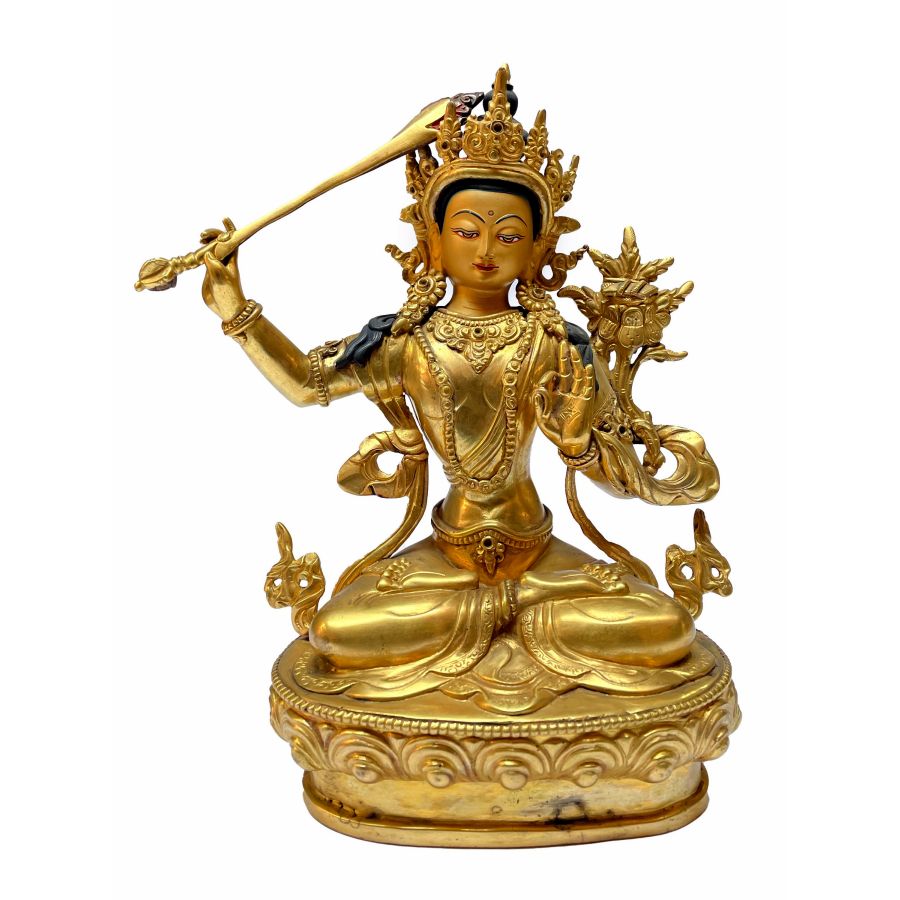
Manjushree: Brief IntroductionManjushree is a Sanskrit word meaning 'gentle glory'. In Sanskrit shree means 'glorious or honorable' His name means who embodies enlightened wisdom. He confers mastery of the Dharma wisdom and eloquence and teaches the path of a bodhisattva in the Mahayana tradition.
Manjushree is the Bodhisattva who holds the flaming sword [Skt. Khadga] of enlightenment by his left hand in a warning( Tarjani) hand gesture ( Mudra) in his left hand representing his realization of wisdom to cut through ignorance & wrong view. His right hand depicted in teaching (Jnana Mudra) holds the stem of a Blue Lotus (Utpala) flower upon which rests the Book (Pustaka) of Perfection of Transcendental Wisdom. The blue lotus is a symbol of the victory of the spirit over the senses and signifies the wisdom of knowledge. This represents the lotus that he obtained from the middle of the lake in the Kathmandu Valley out of which grew a lotus bearing a Blue Flame which represents wisdom. Manjushree sits upon a moon disc upon a lotus with an elongated stem arising from a lake. He wears a gold diadem fitted with precious jewels. He wears a silk scarf fastened at the waist and over this a softly glowing green scarf decorated with golden motifs. His head is silhouetted against a nimbus. The lotus he is sitting on has an elongated stem and arises from a lake representing his recovery of the blue flame of transcendent wisdom and the teaching he originated. The white sash is the attire of the Vajrayana school of Buddhism.CommentaryAccording to legend Manjushree founded the Nepalese civilisation. In ancient times way before Buddha Shakyamuni the Kathmandu Valley was a vast lake. The Buddha Vipashyin came to Nepal to meditate upon the hill above the lake. Wishing to give the rough mountain people an object of worship Vipashyin threw a lotus seed into the lake. When this lotus bloomed a blue flame of wisdom light shone from the centre of its thousand petals. This light was called the Swayambhunath Dharmadhatu the Self-Sprung Infinite Field of Light and the flame of the enlightened mind of the primal Buddha Vajradhara burned at its center. The light of Vajradhara also emanated in the colours of the rainbow and in each of the five colours appeared one of the Five Buddhas - Vairochana Akshobhya Ratnasambhava Amitabha and Amoghasiddhi. Then Manjushri went to Nagarkot Peak on the edge of the lake and after having pondered in Samadhi how best the lake may be drained with his keen edged sword of wisdom he cut three Gorges. After the lake had been drained and the Valley bottom made suitable for cultivation Manjushree founded the city of Patan which was originally called Manjupattan. He taught the people many things. Manjushree manifests himself in the form of Yamantaka known also as Vajrabhairava in order to overcome the lord of Death Yama.
The Book (Pustaka) represents Transcendent Wisdom which came to beembodied by the Dyani {Pancha} Buddha Families. The book symbolically contains Buddhist teaching that had been lost to mankind & which was revealed to Manjushree. The book is commonly mistaken for the Prajna Paramita which was written by many hands between 100 & 200 CE realising the Boddhisattva Principle. The book of Manjushree alludes to Wisdom and the emanation of the Five Transcendent Buddha Families. These are Vairochana Akshobhya Ratnasambhava Amitabha & Amoghasiddhi. Wisdom Energy is a power which can extinguish the Five Negative afflictions. Each family heads wisdom energy to overcome these Five hindrances to enlightenment which are greed hatred delusion jealousy & pride.